
Can Exercise Save Your Sight? The Surprising Link Between Movement and Macular Health
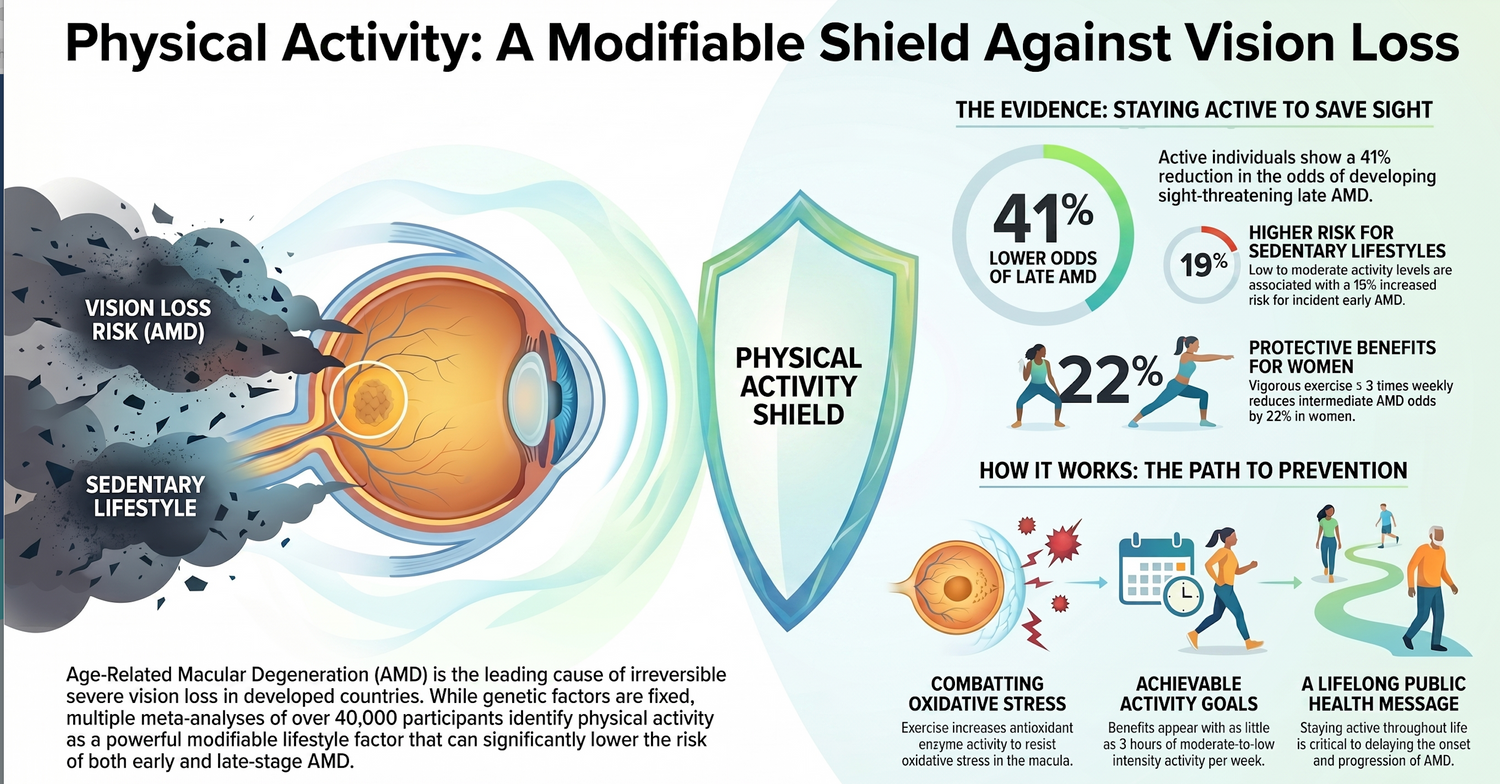
Age-related Macular Degeneration (AMD) stands today as the leading cause of irreversible severe vision loss in developed countries. For many, a diagnosis feels like an inevitable collision with biology—a predetermined outcome written in our "bad genes" or an inescapable tax on the aging process. While genetics and time are powerful players, the latest research suggests we are far from powerless. Emerging evidence has identified a potent, modifiable tool that can act as a protective shield for our eyes: physical activity.
Two landmark scientific efforts—a 2017 systematic review and a 2021 multicohort study—have finally quantified this link. Together, they offer a compelling narrative: the lifestyle choices we make today are directly tied to the clarity of our vision decades from now.
1. Movement is a Modifiable Shield (Not Just Genetics)
For years, clinical advice for AMD risk management centered almost exclusively on smoking cessation and high-dose antioxidant supplements. However, modern research is broadening that horizon. Findings from a 2017 systematic review and a 2021 study of over 14,000 participants demonstrate that AMD is not merely a matter of luck. Scientists now view movement as a "modifiable risk factor," a variable within our control that can fundamentally alter the trajectory of our retinal health.
It is important to note that these specific meta-analyses focused on White/Caucasian populations; while these findings are robust, scientists are still working to determine if they generalize perfectly to other ethnic groups. Nevertheless, for those at risk, this shift in focus empowers a proactive rather than reactive stance. It also clarifies that protective measures should address the disease at every stage, from the appearance of yellow deposits (drusen) in early AMD to the devastating late-stage disease, which includes both "Dry" (geographic atrophy) and "Wet" (neovascular) forms. As the 2017 study concluded:
"Physical activity is associated with lower odds of both early and late AMD in white populations... reinforcing the public health message of staying active throughout life."
2. The 41% Factor: Slashing the Odds of Late-Stage Disease
The 2017 meta-analysis produced a figure that should make every sedentary adult take notice: physically active individuals had 41% lower odds (Odds Ratio 0.59) of developing late AMD compared to those who remained sedentary.
This is a critical distinction. While early AMD is often non-sight-threatening, late AMD—the stage where "wet" vessels leak or retinal cells wither away—is the primary driver of blindness. This stage also carries a massive economic burden, costing an estimated $24.4 billion annually in the U.S. and €89.5 billion in the E.U.
Interestingly, while the 2021 multicohort study confirmed the benefits for early-stage disease, it was "underpowered" to show the same statistically significant result for late AMD. This doesn't mean the benefit disappeared; rather, late-stage events were simply too rare during that specific follow-up window to confirm the effect with the same mathematical certainty as the 2017 review.
3. The "Sixth Decade" Window of Opportunity
The 2021 E3 Consortium study, which analyzed seven population-based cohorts, uncovered a "window of opportunity" that suggests timing is everything. While activity is beneficial throughout life, the protective effect was most pronounced in the youngest cohorts, specifically those in their 6th decade of life (the 50s and 60s).
The data here is striking: in the youngest cohort studied (the Gutenberg Health Study), those who remained sedentary were 74% more likely (Hazard Ratio 1.74) to develop early AMD than their highly active peers. Across all combined cohorts, the average risk increase for the sedentary was still a significant 19%.
Choosing to stay active in your 50s effectively slashes the hazard of early-stage disease. This shifts our medical philosophy from managing a chronic condition to preventing its very first signs from ever manifesting.
4. You Don’t Need to Be a Marathon Runner
One of the most encouraging takeaways for any longevity-focused individual is that the "dose" of exercise required for protection is remarkably manageable. You don't need to be an elite athlete. The 2017 research suggests that even low-to-moderate levels of activity confer significant benefits.
The evidence indicates that as little as three hours of moderate-to-low-intensity activity per week—or just 15 minutes a day—is associated with better macular health. Concrete examples of beneficial movement include:
- Walking and leisure sports
- Cycling
- Vigorous gardening
- Common household tasks, such as carrying loads
There is also a fascinating "sunlight conundrum" buried in the data. A re-examination of the Beaver Dam Eye Study found that "blocks walked" (typically an outdoor activity) showed a clear protective benefit, while "stair climbing" (typically performed indoors) did not. This suggests that the benefits of exercise might be partially mediated by Vitamin D synthesis from sunlight, though more research is needed to untangle this relationship.
5. Building Biological Armor Against Oxidative Stress
Why does a daily walk help your retinas? The answer lies in the high-performance nature of the eye. The macula has an incredibly high metabolic turnover, making it a "hot zone" for oxidative stress—the cellular damage caused by unstable molecules.
Regular physical activity acts like a holistic drug, "training" the eye’s internal defenses by:
- Boosting Antioxidants: Increasing the activity of enzymes that neutralize harmful molecules before they damage the retina.
- Reducing Inflammation: Lowering systemic inflammation that can otherwise degrade retinal tissue.
- Improving Vascular Health: Exercise supports the complex network of blood vessels that feed the eye, ensuring the retina receives the oxygen and nutrients it needs to survive.
While supplements have their place, they cannot fully replicate the way exercise strengthens the body’s internal systems and vascular health from the inside out.
A Thought-Provoking Conclusion
The science is increasingly clear: our lifestyle choices today are directly linked to the clarity of our vision decades from now. We no longer have to view Age-related Macular Degeneration as an inevitable byproduct of the years passing by. While we await further longitudinal studies to define the perfect "dose" of movement, the current evidence is a powerful call to action for anyone interested in long-term health.
If a 30-minute daily walk could be the difference between seeing your grandchildren clearly or facing irreversible vision loss, is it time to rethink your sedentary routine?
Frequently Asked Questions (FAQs)
What level of activity is needed for a protective effect?
Even modest amounts of physical activity can confer a protective effect against age-related macular degeneration (AMD). A meta-analysis indicates that as little as 3 hours of moderate-to-low-intensity physical activity per week may be sufficient to provide a beneficial health effect. The relationship between physical activity and AMD risk reduction is "convex," meaning that the steepest and most significant protective gains occur simply by transitioning from a completely sedentary lifestyle to engaging in modest activity.
To achieve optimal protective effects, the sources outline specific activity targets, dose-response relationships, and frequencies:
- Standard Clinical Target: Clinical protocols generally recommend aiming for more than 150 minutes of moderate activity per week. This is roughly the energy equivalent of walking briskly for 30 minutes, 5 days per week.
- Incremental Dose-Response (Distance): The protective benefits of vigorous activity, such as running, increase steadily with the volume of exercise. For every 1 kilometer per day (km/d) increase in average running distance, the relative risk of developing AMD decreases by approximately 10%
- Specific Volume Thresholds: Compared to individuals who average less than 2 km/day, higher volumes yield increasingly substantial risk reductions:
- Simply reaching 2 km/day yields a statistically significant 36% risk reduction.
- Averaging 2 to 4 km/day (which is roughly twice the minimum recommended public health guidelines) results in a 19% lower adjusted risk.
- Averaging >4 km/day (three times the minimum recommended guidelines) reduces the risk by 42% to 54%.
- Averaging ≥8 km/day offers the most profound protection, lowering the risk of AMD by 54% to 59%.
- Frequency Targets: When considering the frequency of workouts, engaging in vigorous exercise 3 or more times per week is the specific activity level associated with a 22% decreased risk of developing intermediate AMD in women
Does exposure to sunlight during outdoor exercise raise AMD risk?Current research does not provide strong evidence that sunlight exposure during outdoor physical activity increases the risk of Age-Related Macular Degeneration (AMD). Although a 2012 meta-analysis suggested a possible link, its findings were heavily influenced by smaller studies that did not fully adjust for confounding factors. As a result, the conclusion remains uncertain, and stronger, more controlled evidence is needed before sunlight can be considered a meaningful risk factor that offsets the benefits of exercise.
When comparing indoor and outdoor activity, studies do not show that being outside reduces the protective effects of physical movement. In fact, several findings suggest outdoor activity may offer additional advantages:
-
No clear association with AMD risk: Large observational research, including data from the Eye Disease Case-Control Study, found no relationship between time spent outdoors, occupational sun exposure, or even sunglasses use and AMD prevalence.
-
Stronger protective signals outdoors: The Beaver Dam Eye Study reported that walking—typically an outdoor activity—was linked to a lower risk of developing wet AMD, whereas indoor activities like stair climbing did not show the same effect.
-
Possible role of vitamin D: Outdoor exercise is often associated with higher vitamin D levels, which may play a supportive role in retinal health and disease modulation, although this link is still being explored.
Overall, the benefits of regular physical activity for AMD prevention appear to remain consistent regardless of whether the activity is performed indoors or outdoors, with some evidence suggesting added value from time spent outside.
References:
- zhou-et-al-2025-genetically-determined-physical-activity-levels-sedentary-behaviours-and-their-association-with-the.pdf
- The Impact of Physical Exercise on Oxidative and Nitrosative Stress: Balancing the Benefits and Risks - MDPI, accessed January 18, 2026, https://www.mdpi.com/2076-3921/13/5/573
- Oxidative stress: role of physical exercise and antioxidant nutraceuticals in adulthood and aging - PMC - PubMed Central, accessed January 18, 2026, https://pmc.ncbi.nlm.nih.gov/articles/PMC5908316/
- Reductive carboxylation is a major metabolic pathway in the retinal pigment epithelium | PNAS, accessed January 18, 2026, https://www.pnas.org/doi/10.1073/pnas.1604572113
- Aerobic Exercise Protects Retinal Function and Structure from Light-Induced Retinal Degeneration - PMC - NIH, accessed January 18, 2026, https://pmc.ncbi.nlm.nih.gov/articles/PMC3921416/
- Aerobic Exercise Protects Retinal Function and Structure from Light-Induced Retinal Degeneration | Journal of Neuroscience, accessed January 18, 2026, https://www.jneurosci.org/content/34/7/2406.short
- Enhancing Retinal Resilience: The Neuroprotective Promise of BDNF in Diabetic Retinopathy - MDPI, accessed January 18, 2026, https://www.mdpi.com/2075-1729/15/2/263
- Effect of isometric exercise on choroidal blood flow in patients with age-related macular degeneration - PubMed, accessed January 18, 2026, https://pubmed.ncbi.nlm.nih.gov/20837789/
- EFFECT OF ISOMETRIC EXERCISE ON CHOROIDAL BLOOD FLOW IN PATIENTS WITH AGE-RELATED MACULAR DEGENERATION (AMD) - PubMed Central, accessed January 18, 2026, https://pmc.ncbi.nlm.nih.gov/articles/PMC4077432/
- Exercise for Eyes and Vision - American Academy of Ophthalmology, accessed January 18, 2026, https://www.aao.org/eye-health/glasses-contacts/exercise-eyes-vision-4
- Age-Related Macular Degeneration Is Associated with Less Physical Activity among US Adults: Cross-Sectional Study | PLOS One - Research journals, accessed January 18, 2026, https://journals.plos.org/plosone/article?id=10.1371/journal.pone.0125394

Leave a comment
This site is protected by hCaptcha and the hCaptcha Privacy Policy and Terms of Service apply.