
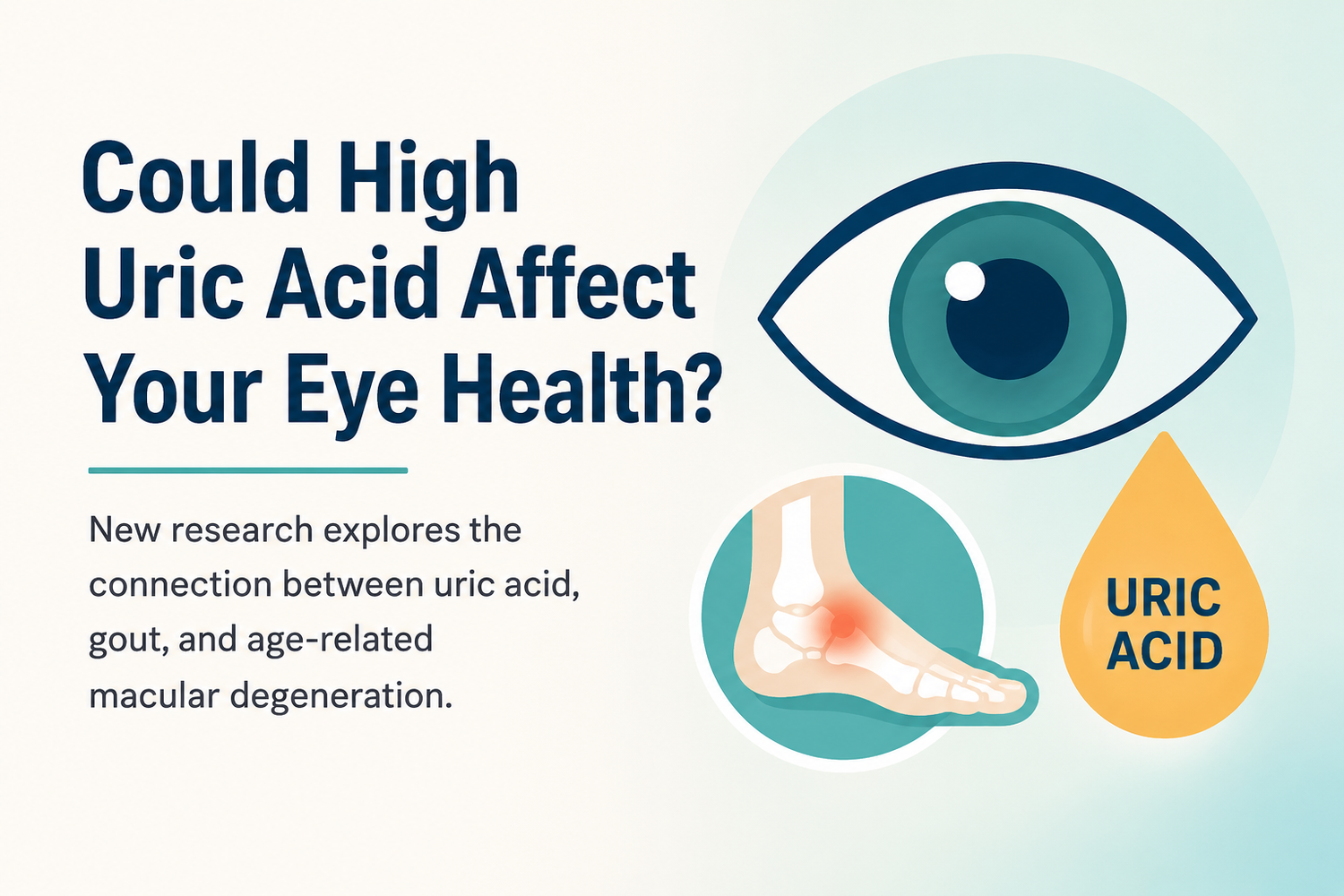
Gout and Macular Degeneration
More Than Just a Joint Problem: The Surprising Link Between Gout and Your Vision
When most people think of gout, they picture a painfully swollen big toe or a stiff, throbbing joint. However, expert focus is shifting from the feet to the eyes. Age-Related Macular Degeneration (AMD) is the leading cause of vision loss in older adults, currently affecting approximately 20 million Americans. While aging and genetics are the traditional suspects, a compelling body of research is looking at metabolic health—specifically the management of uric acid—as a critical, once-overlooked factor in long-term retinal health.
Takeaway 1: The "2.7x" Risk Factor
A powerful retrospective cohort study published in the journal Retina (2025) has identified gout as a significant independent risk factor for vision loss. This wasn't a small-scale observation; researchers analyzed data from 16,433 patients per cohort—totaling over 32,000 matched patients—providing massive statistical weight to the findings.
By the five-year mark, the study found that patients with gout faced a dramatically higher likelihood of developing various forms of AMD:
- Dry AMD: 2.73 times higher risk.
- Advanced Dry AMD (Geographic Atrophy): 2.64 times higher risk.
- Wet AMD: 2.48 times higher risk.
These numbers suggest that the inflammatory environment associated with gout isn't just a localized joint problem. Instead, a diagnosis of gout serves as a potent indicator of systemic vulnerability that includes the retina.
Takeaway 2: The "Dr. Jekyll and Mr. Hyde" of Uric Acid
To understand this link, science points to the "dual nature" of uric acid (UA). Research reviewed in The FASEB Journal describes UA as a biochemical paradox, acting differently depending on where it sits in the body.
In the plasma—the intercellular environment (meaning the space outside or between cells)—uric acid acts like "Dr. Jekyll." It is a vital antioxidant that helps neutralize harmful free radicals and peroxynitrite. However, when levels are persistently high and UA moves into the intracellular environment (inside the cells), it can transform into "Mr. Hyde."
As the journal explains:
"UA stands out for its efficacy in countering peroxynitrite, thereby offering a protective role... [however] inside cells, elevated uric acid may have the opposite effect... it may promote oxidative stress, inflammatory signaling, and cellular damage."
This internal imbalance is believed to contribute specifically to the degeneration of the delicate tissues in the macula.
Takeaway 3: "Gout of the Eye"—Crystals in the Retina
Researchers are currently exploring a hypothesized pathway often referred to as a "newly conceptualized entity": hyperuricemic AMD. The theory suggests that monosodium urate (MSU) crystals—the same culprits behind joint flares—may deposit within the retinal pigment epithelium (RPE).
While still an emerging theory rather than an established clinical diagnosis, evidence points toward a "shared mechanism" of inflammation:
- The NLRP3 Inflammosome: These crystals are thought to activate the NLRP3 inflammasome, a molecular alarm system that triggers a cascade of inflammatory cellular death (pyroptosis).
- The Renin-Angiotensin System (RAS): High uric acid may activate the RAS within eye tissues. This activation is particularly concerning because it can lead to VEGF-mediated pathological processes, which stimulate the growth of the abnormal, leaky blood vessels characteristic of "wet" AMD.
Takeaway 4: A Faster Track to Advanced Disease
For those who already have early-stage AMD, the presence of gout appears to accelerate the disease, leading to a much higher burden of treatment.
The 2025 study revealed that patients with gout were 2.80 times more likely to need their first anti-VEGF injection compared to those without gout. Furthermore, once treatment began, the disease was more difficult to manage:
- Gout Patients: Required an average of 6.54 injections.
- Non-Gout Patients: Required an average of 4.71 injections.
This increased frequency of medical intervention highlights that metabolic health doesn't just influence if you get the disease, but how aggressively it progresses.
Takeaway 5: Eye Health is Metabolic Health
The silos between rheumatology and ophthalmology are breaking down. Protecting your vision now requires an interdisciplinary approach that views the eye as a window into your metabolic status.
For individuals managing gout or high uric acid, the following preventative steps are essential for supporting long-term vision:
- Prioritize Comprehensive Eye Exams: Detection of early retinal changes is critical when metabolic risk is high.
- Adhere to Uric Acid-Lowering Therapy (ULT): Managing levels through medication is the most actionable step. Notably, research has associated the use of Allopurinol with a lower hazard of developing AMD (a reduction of roughly 11%).
- Weight Management: Maintaining a healthy BMI addresses a shared risk factor for both gout flares and retinal damage.
- Targeted Nutritional Support: Beyond the standard AREDS formula (Vitamins C, E, and Zinc), consider natural agents associated with reduced risk, such as melatonin and curcumin, which have shown potential in supporting retinal health.

Conclusion: A New Piece of the Puzzle
We are entering a new era of wellness where we recognize that the health of our eyes is inseparable from our systemic metabolism. Uric acid metabolism, once the exclusive domain of joint health, has emerged as a critical piece of the AMD puzzle.
By managing your metabolic markers today, you are doing more than just preventing a painful flare—you are actively shielding your sight for the years to come. If managing your metabolic health today could save your central vision tomorrow, would you change how you look at your next health check-up?
References:
- Pai HL, Lin DPC, Chang HH. Current updates for hyperuricemia and gout in age-related macular degeneration. FASEB J. 2024;38:e23676. doi:10.1096/fj.202400421R.
- Alshaikhsalama AM, Alsoudi AF, Wai KM, Koo E, Mruthyunjaya P, Rahimy E. Gout and risk of age-related macular degeneration. Retina. 2025;45(12):2289-2296.
- Singh JA, Cleveland JD. Gout and the risk of age-related macular degeneration in the elderly. PLoS One.2018;13(7):e0199562. doi:10.1371/journal.pone.0199562.
- Hsu MH, Hsu CA, Lai SC, Yen JC. Gout as a risk factor for age-related macular degeneration in Taiwanese adults: a population-based study in Taiwan. Int J Environ Res Public Health. 2022;19:10142.
- Subramani S, Khor SE, Livingstone BI, Kulkarni UV. Serum uric acid levels and its association with age-related macular degeneration (ARMD). Med J Malaysia. 2010;65:36-40.
- Jiang Y, Brenner JE, Foster WJ. Retinal complications of gout: a case report and review of the literature. BMC Ophthalmol. 2018;18:11.

Leave a comment
This site is protected by hCaptcha and the hCaptcha Privacy Policy and Terms of Service apply.