
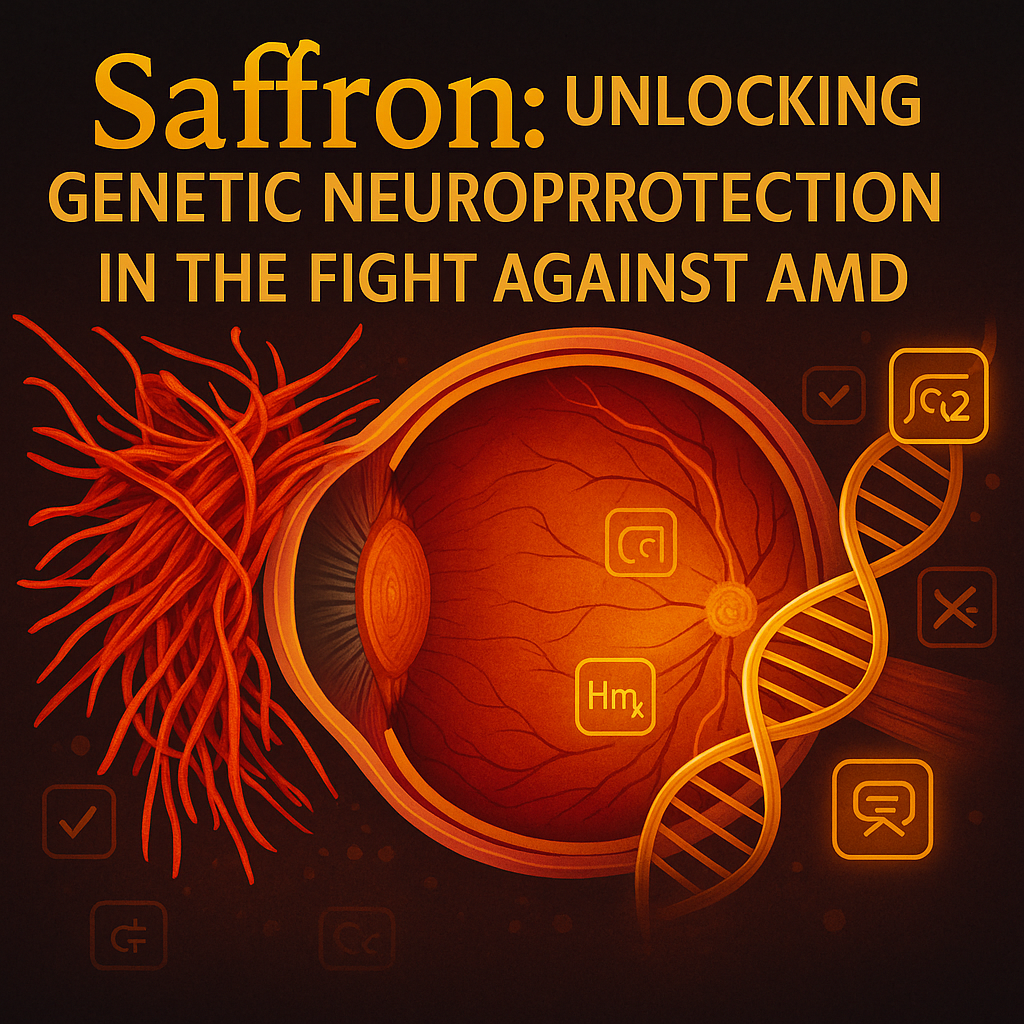
Saffron and the Retina: How a Natural Spice Influences the Genetic Defenses That Protect Your Vision
Age-related macular degeneration (AMD) is often described in terms of drusen, inflammation, and oxidative stress—but the real story is deeper. Modern research is revealing that AMD is driven by an intricate web of genetic responses, mitochondrial stress, and cellular communication signals inside the retina.
Surprisingly, one natural ingredient—saffron—has shown the ability to influence several of these genetic pathways in ways that support retinal resilience. Recent laboratory and clinical studies suggest that saffron doesn’t just work as an antioxidant supplement; it interacts with the retina’s built-in protective programs, affecting genes that help control inflammation, oxidative stress, and photoreceptor survival.
Below, we explore how saffron engages with these biological systems, and why this research is adding new momentum to saffron’s role in supporting macular health.
Why Genes Matter in AMD
AMD develops over many years due to a combination of factors:
- oxidative stress
- light-induced damage
- lipid peroxidation
- iron accumulation
- inflammatory signaling
- mitochondrial dysfunction
These stressors activate or suppress specific genes inside retinal cells.
When these genes shift in a harmful direction, the retina becomes more vulnerable to damage.
This makes gene modulation an attractive scientific target—anything that nudges retinal genes toward healthier activity may help protect the macula over time.
How Saffron Appears to Modulate Key Retinal Genes
Research shows that saffron influences a wide array of genes involved in the retina’s stress response. Here are some of the major pathways affected:
1. Reducing Inflammatory Signals (Ccl2 and others)
Chronic low-grade inflammation is a hallmark of AMD.
Ccl2 is one of the genes responsible for attracting inflammatory cells to stressed tissue.
Saffron has been shown to decrease Ccl2 activity, resulting in:
- less inflammatory cell recruitment
- reduced tissue stress
- a calmer retinal environment
This shift is meaningful because overactive inflammatory pathways accelerate AMD progression.
2. Supporting Antioxidant Defense (Hmox1, Gpx3)
Retinal cells are constantly exposed to oxidative stress due to high oxygen use and light exposure.
Two genes are central to this defense:
- Hmox1 — a stress-response gene activated by oxidative injury
- Gpx3 — an enzyme that detoxifies harmful peroxides
In studies, saffron helped normalize Hmox1 and maintain Gpx3 expression when the retina was under phototoxic stress.
This suggests saffron may help the retina retain strong, balanced antioxidant capacity.
3. Enhancing Photoreceptor Survival (Edn2 and repair pathways)
Edn2 increases when photoreceptors are stressed.
It communicates with survival-supporting molecules such as FGF-2, a factor known to delay photoreceptor degeneration.
Saffron raises Edn2 expression, which may:
- activate repair signals
- promote photoreceptor resilience
- strengthen the retina’s natural recovery mechanisms
This is particularly important in early and intermediate AMD.
4. Helping Maintain Metabolic Stability (Fabp5, Crot, Smarcd1)
Photoreceptors are among the most energy-hungry cells in the human body.
Their metabolism must remain stable for vision to function.
Saffron influences several genes involved in:
- fatty acid transport
- fuel utilization
- mitochondrial balance
These pathways help sustain the retina’s energy system during stress.
5. Supporting Neuronal Communication (Optn, Stat3, Socs3)
Vision depends on precise communication between retinal cells.
Genes like Optn, Stat3, and Socs3 regulate signaling, inflammation, and cell survival.
Saffron’s modulation of these pathways may help maintain healthier communication between photoreceptors, bipolar cells, and the rest of the retinal circuitry.
The Emerging Role of Non-Coding RNAs (ncRNAs)
A major insight from recent AMD research is the role of non-coding RNAs, small regulatory molecules that influence gene expression.
These ncRNAs control:
- mitochondrial health
- oxidative stress responses
- immune activation
- fat metabolism
- photoreceptor survival
Some studies show saffron interacts with ncRNAs involved in antioxidant and metabolic balance, suggesting another promising layer of biological influence.
What This Means for AMD Prevention and Support
AMD is driven by stress pathways that build up slowly over decades.
Because saffron interacts with the genes and molecular signals behind oxidative stress, inflammation, and energy regulation, it offers a unique multi-pathway approach to retinal support.
Potential advantages include:
- improved resistance to oxidative damage
- better inflammatory balance
- enhanced survival signals in photoreceptors
- healthier mitochondrial activity
- more stable metabolic function
This does not replace medical treatments, but it strengthens the scientific basis for saffron as part of a holistic, long-term macular health strategy.
Looking Ahead: Gene-Smart Nutrition for the Eyes
Nutritional approaches to eye health are evolving.
Researchers are increasingly focusing on how nutrients influence gene activity, molecular signaling, and cellular stress responses.
Saffron stands out because:
- it affects multiple AMD-related pathways at the genetic level
- it supports retinal metabolism
- it reinforces antioxidant and anti-inflammatory defenses
- early clinical and laboratory findings show consistent neuroprotective effects
As the science moves forward, saffron may become an important component of gene-informed nutritional strategies for maintaining macular health and supporting retinal resilience.
References:
1- Gene and noncoding RNA regulation underlying photoreceptor protection: microarray study of dietary antioxidant saffron and photobiomodulation in rat retina
http://www.molvis.org/molvis/v16/a196/
2- Non-Coding RNAs Regulating Mitochondrial Functions and the Oxidative Stress Response as Putative Targets against Age-Related Macular Degeneration (AMD)
https://www.mdpi.com/1422-0067/24/3/2636

Leave a comment
This site is protected by hCaptcha and the hCaptcha Privacy Policy and Terms of Service apply.