
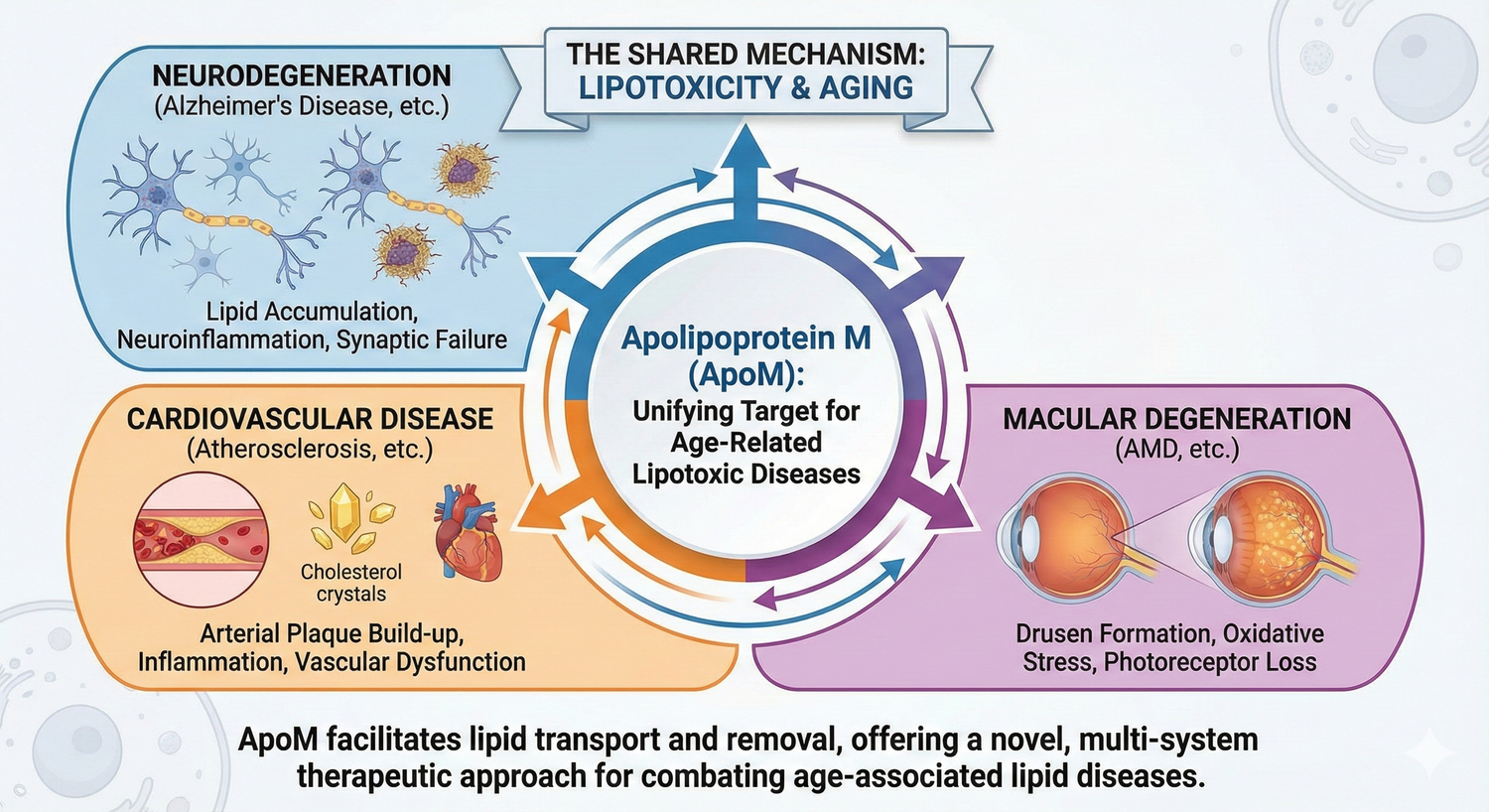
ApoM: A Central Player in Age-Related Macular Degeneration Lipotoxicity and Vision Health
As we learn more about age-related diseases, a recurring theme is emerging: lipid imbalance plays a powerful role in driving cellular stress, inflammation, and long-term tissue damage. One protein increasingly recognized as a key regulator in this process is Apolipoprotein M (ApoM).
ApoM sits at the crossroads of lipid metabolism, metabolic health, and age-related tissue resilience—including the delicate structures of the macula. Research suggests that ApoM may act as a protective signal against lipotoxic damage, making it a compelling target across multiple systems affected by aging.
What Is ApoM and Why Does It Matter?
ApoM is a protein mainly carried on HDL particles, the so-called “good cholesterol.” But its functions go far beyond cholesterol transport.
ApoM binds to and carries sphingosine-1-phosphate (S1P)—a lipid mediator essential for:
- Maintaining healthy blood vessels
- Regulating inflammation
- Supporting cellular survival pathways
- Protecting tissues from oxidative stress
Because S1P is such a vital signaling molecule, the ApoM–S1P axis is now viewed as a guardian system that helps tissues withstand metabolic and inflammatory challenges.
Lipotoxicity: The Hidden Driver of Age-Related Disease
As we age, the body becomes more vulnerable to lipid overload, especially in metabolically active tissues. This process—called lipotoxicity—occurs when fats accumulate in places they shouldn’t, triggering:
- Mitochondrial dysfunction
- Oxidative damage
- Chronic inflammation
- Cell stress and death
These same pathways also play a role in age-related vision changes, particularly those involving the macula.
ApoM becomes important here because it helps buffer tissues from the damaging effects of lipid excess.
ApoM Across Multiple Age-Related Conditions
Because the ApoM–S1P system influences vascular signaling, inflammation, and cellular resilience, it intersects with many common age-related conditions:
1. Metabolic Health
ApoM levels are strongly linked to insulin sensitivity, glucose balance, and metabolic flexibility.
Low ApoM levels can worsen the metabolic environment that contributes to lipotoxic damage.
2. Cardiovascular Health
Through its role in HDL function and vascular protection, ApoM supports endothelial integrity and helps reduce inflammatory stress on blood vessel walls.
3. Liver Function
The liver is highly vulnerable to lipid overload. Studies suggest ApoM helps counteract the inflammatory and oxidative effects associated with fatty liver states.
4. Macular and Retinal Health
Although research is ongoing, the mechanisms regulated by ApoM—lipid handling, inflammation control, vascular stability—are all relevant to macular resilience as we age.
Because the retina is one of the most metabolically active tissues in the body, maintaining healthy lipid dynamics is essential for long-term visual function.
ApoM as a Unifying Concept in Age-Related Lipid Imbalance
What makes ApoM unique is its reach.
Rather than influencing a single pathway, ApoM sits at the intersection of:
- HDL biology
- Lipid signaling
- Inflammation
- Endothelial function
- Tissue repair
This multi-system involvement is why scientists consider ApoM a potential “unifying target” for many lipotoxic diseases associated with aging.
Supporting ApoM and S1P signaling—indirectly through lifestyle, nutrition, and metabolic health—may help maintain tissue resilience across the body, including in the eyes.
The Future of ApoM Research
The field is rapidly evolving. Researchers are investigating:
- How ApoM levels change with age
- Genetic factors that influence ApoM expression
- The role of ApoM in protecting metabolically active tissues
- Whether supporting ApoM pathways could help reduce lipid-driven cell stress
While we are still in the early stages of understanding the full potential of ApoM, it is clear that this protein will be central to future discussions on age-related metabolic and vision health.
Key Takeaway
ApoM is emerging as a critical protector against the consequences of lipid overload.
By regulating S1P signaling, modulating inflammation, and supporting vascular and cellular resilience, ApoM acts as a bridge between metabolic health and long-term tissue protection—including in the macula.
Understanding ApoM is part of a broader scientific effort to better address the underlying biological processes that shape healthy aging.
References
- Apte, R. S., et al. (2025). ApoM ameliorates RPE functional deficits in a murine dry AMD-like model. Nature Communications. 1 https://pmc.ncbi.nlm.nih.gov/articles/PMC12187922/
- Apte, R. S., et al. (2025). Apolipoprotein M Inhibits Angiogenic and Inflammatory Response by Sphingosine 1-Phosphate on Retinal Pigment Epithelium Cells. Investigative Ophthalmology & Visual Science (IOVS). 17https://iovs.arvojournals.org/article.aspx?articleid=2691003
- Apte, R. S., et al. (2025). Strategy to prevent age-related macular degeneration identified. Washington University School of Medicine News. 3 https://medicine.washu.edu/news/strategy-to-prevent-age-related-macular-degeneration-identified/
- Apte, R. S., et al. (2025). The ApoM Pathway May Offer New Target for Early AMD Intervention. Retinal Physician. 18 https://www.retinalphysician.com/issues/2025/julyaugust/apom-pathway-may-offer-new-target-for-early-amd-intervention/
- Baldwin, M. A. (2004). Protein identification by mass spectrometry: issues to be considered. Molecular & Cellular Proteomics. 29 https://pmc.ncbi.nlm.nih.gov/articles/PMC8487476/
- Bressler, N. M., et al. (1995). Five-year incidence and disappearance of drusen and retinal pigment epithelial abnormalities. Archives of Ophthalmology. 2 https://pmc.ncbi.nlm.nih.gov/articles/PMC11492580/
- Ding, Y., et al. (2015). Apolipoprotein M and its ligand sphingosine-1-phosphate in health and disease. Biochimica et Biophysica Acta (BBA) - Molecular and Cell Biology of Lipids. 27 https://pubmed.ncbi.nlm.nih.gov/25551802/
- Do, H., et al. (2024). Low plasma apolipoprotein M levels are associated with major adverse cardiovascular events in chronic kidney disease. Arteriosclerosis, Thrombosis, and Vascular Biology. 10https://www.ahajournals.org/doi/10.1161/ATVBAHA.124.322367
- Frontiers in Medicine. (2021). The functional role of kidney-derived apoM as well as plasma-derived apoM is far from elucidated. Frontiers in Medicine. 23https://www.frontiersin.org/journals/medicine/articles/10.3389/fmed.2021.754490/epub
- Frontini, A., et al. (2024). Novel therapeutic strategy targeting ApoM/S1P in neovascular AMD. Vascular Biology. 13 https://pmc.ncbi.nlm.nih.gov/articles/PMC12018641/
- Hla, T., et al. (2019). Apolipoprotein M-bound sphingosine-1-phosphate regulates blood-brain barrier paracellular permeability and transcytosis. eLife. 30 https://elifesciences.org/articles/49405/peer-reviews
- Hla, T., et al. (2019). S1PR1-mediated signaling enhances the efficacy of checkpoint blockade. Proceedings of the National Academy of Sciences (PNAS). 31 https://www.pnas.org/doi/10.1073/pnas.1906246117
- Iio, A., et al. (2017). S1P signaling pathways and their implications in metabolic syndrome. International Journal of Molecular Medicine. 28 https://www.spandidos-publications.com/10.3892/mmr.2015.3658
- Lee, T. Y., et al. (2024). ApoM linked to AMD and heart disease treatment. Ophthalmology Breaking News. 9https://ophthalmologybreakingnews.com/apom-linked-to-amd-and-heart-disease-treatment
- Li, M., et al. (2021). The effects of ApoM on macrophage inflammation in atherosclerosis. Translational Medicine Communications. 21 https://pmc.ncbi.nlm.nih.gov/articles/PMC7812182/
- Macular Society. (2023). Second drug for dry AMD becomes available in the US. Macular Society News. 19https://www.macularsociety.org/about/media/news/2023/august/second-drug-for-dry-amd-becomes-available-in-the-us/
- Michaud, C., et al. (2018). S1P regulates HIF-1-dependent cellular responses in RPE cells. International Journal of Molecular Sciences. 32 https://www.mdpi.com/1422-0067/19/1/112
- Neuroscience News. (2024). ApoM deficiency disrupts cholesterol metabolism in the eye and heart. Neuroscience News. 4 https://neurosciencenews.com/apom-amd-genetics-29236/
- Park, E. J., et al. (2017). ApoM suppresses the progression of CNV formation by inhibiting the S1P-induced activation of growth factors and chemokines. Investigative Ophthalmology & Visual Science (IOVS). 16https://pmc.ncbi.nlm.nih.gov/articles/PMC5796061/
- Qian, H. and Hla, T. (2020). S1P-S1P receptor signaling system in inflammatory processes. Frontiers in Pharmacology. 12 https://pmc.ncbi.nlm.nih.gov/articles/PMC6939830/
- Raj, M. N. A., et al. (2013). Lipoproteins are multimolecular assemblies composed of lipid and protein bound by noncovalent forces. Investigative Ophthalmology & Visual Science (IOVS). 33https://iovs.arvojournals.org/article.aspx?articleid=2125735
- Saheki, A., et al. (2017). Sphingosine-1-phosphate (S1P) and its carriers. Journal of Atherosclerosis and Thrombosis. 8 https://www.jstage.jst.go.jp/article/jat/25/1/25_RV17010/_article
- Science Daily. (2025). ApoM helps eye cells sweep away harmful cholesterol deposits. Science Daily. 20https://www.sciencedaily.com/releases/2025/06/250625001724.htm
- Sebag, M., et al. (1991). Image analysis of changes in drusen area. Acta Ophthalmologica. 2https://pmc.ncbi.nlm.nih.gov/articles/PMC11492580/
- Takagi, H., et al. (2024). S1P1/5-selective S1P receptor agonist for exudative AMD. Investigative Ophthalmology & Visual Science (IOVS). 14 https://pmc.ncbi.nlm.nih.gov/articles/PMC11055896/
- The Ophthalmologist. (2025). ApoM-S1P stimulates RPE's lysosomal system to break down lipids more effectively. The Ophthalmologist. 15 https://theophthalmologist.com/issues/2025/articles/july/slowing-amd-progression
- Wang, L., et al. (2023). ApoM/S1P-S1P1 axis might serve as a novel therapeutic target for preventing the development/progression of diabetic nephropathy. Journal of Advanced Research. 25https://pubmed.ncbi.nlm.nih.gov/36805561/
- Wang, M., et al. (2014). ApoM in the kidney contributes to the renal S1P content. PLoS One. 26https://pmc.ncbi.nlm.nih.gov/articles/PMC4234226/
- Wang, S., et al. (2019). The potential for apoM/S1P as biomarkers for inflammation, sepsis and nephropathy. Biomolecules. 24 https://pubmed.ncbi.nlm.nih.gov/31008738/
- Wang, T. and Zhang, Z. (2022). Apolipoprotein M in diabetic nephropathy. Frontiers in Pharmacology. 22https://www.frontiersin.org/journals/pharmacology/articles/10.3389/fphar.2024.1328259/full
- Zhang, S., et al. (2018). The biological function of apolipoprotein M (apoM) and its regulation. Molecular Medicine Reports. 6 https://www.spandidos-publications.com/10.3892/mmr.2015.3658
- Zhang, X., et al. (2023). Sphingosine-1-phosphate (S1P) in cardiovascular functions. International Journal of Molecular Sciences. 11 https://pmc.ncbi.nlm.nih.gov/articles/PMC10216071/
- Zvonic, S. and Hla, T. (2017). The effects of HDL-S1P on cardiovascular health. Current Opinion in Lipidology. 7https://pmc.ncbi.nlm.nih.gov/articles/PMC5756743/
- Zvonic, S., et al. (2022). Aged transgenic APOE mice with targeted replacement of mouse ApoE with human APOE4 develop an AMD-like ocular phenotype. Cells. 34 https://pmc.ncbi.nlm.nih.gov/articles/PMC8817708/

Leave a comment
This site is protected by hCaptcha and the hCaptcha Privacy Policy and Terms of Service apply.